

A God that hears and answers prayer, and we know that nothing, absolutely nothing, is impossible for you. You are Jehovah-Rapha, the God of Israel. And I pray, Father God, that the blood of Jesus Christ, that pours out of you, and touches me, Peter, Lord, drive out that ailment that’s robbing him of life, Lord.
Recover him in the blood, Lord. Amen. Yes. Yes. Yes. Yes. Yes. Hallelujah. Hallelujah.
Hallelujah. Yes. Healing. The healing that flows just through the mention of his name. Hallelujah to Jesus. Healing from the crown of the head to the soles of the feet. Nothing, nothing is impossible with God. Hallelujah. Hallelujah. Hallelujah. We are living stories, testimonies of the goodness of God. Hallelujah.
Thank you, Lord Jesus. Thank you, Lord Jesus. She’s got challenges with her sight. So Heavenly Father, thank you for this precious lady. We all love her dearly, but not nearly as much as you do. So we ask the tender love of Jesus, would cause you to extend your healing hand to her person. Restore her sight. Lord, we read in the gospels wonderful stories of eyesight being restored. The same Jesus, the same Jesus is among us now. And we ask you for this healing miracle in your name. Amen. Amen.
Amen. Bless you, Cheryl. Thank you. I choose in the scripture reading this morning, in John’s gospel, chapter 2, Jesus has just completed his invitations to his disciples with the fellow whose name is Nathaniel. And interesting that the very next thing that happens in this journey of Jesus follows right after, probably not more than two days after he chose Nathaniel. And you remember the story about Nathaniel. Jesus sees him at some distance and says, Now there is a man, there’s a man I can trust. There’s a man in whom there’s no guile. And then Nathaniel is invited to come closer. And as he has heard those words, he’s amazed. And he said, you don’t even know me. I’m not sure you could even see me where I was standing.
And surely you are the Messiah. You’re the one we’re looking for. Two days, it seems, later, Jesus is invited to a wedding feast. And his mother Mary is invited. And somehow or other, his disciples are invited as well. Why would the disciples be invited as well? Well, a brief study of the geography of that area would tell you that Nazareth was a very, very small community.
I mean, very small. Not an industrious thing at all. But it was the next town that was significantly larger. And a lot of the people in Nazareth probably went and worked in that next village. So, when you have small village life, you have a lot of intermarriage.
You have cousins. And everybody seems to know everybody. Somebody down in the end house sneezes, and everybody all the way up the street yells, Gesundheit. So, it’s no wonder that Mary was invited. She could very well have been related to either the bride or the groom, or the person who was orchestrating the feast that was about to take place. Jesus would have also been known, but he wasn’t known at this point as the miracle worker. This, in fact, was the first miracle that Jesus performed. So, he wasn’t invited because of notoriety. I think he was invited because he was Jesus. Maybe everybody knew him. Or maybe he was invited because of Mary. So, it says that on the third day, there was a wedding in Cana.
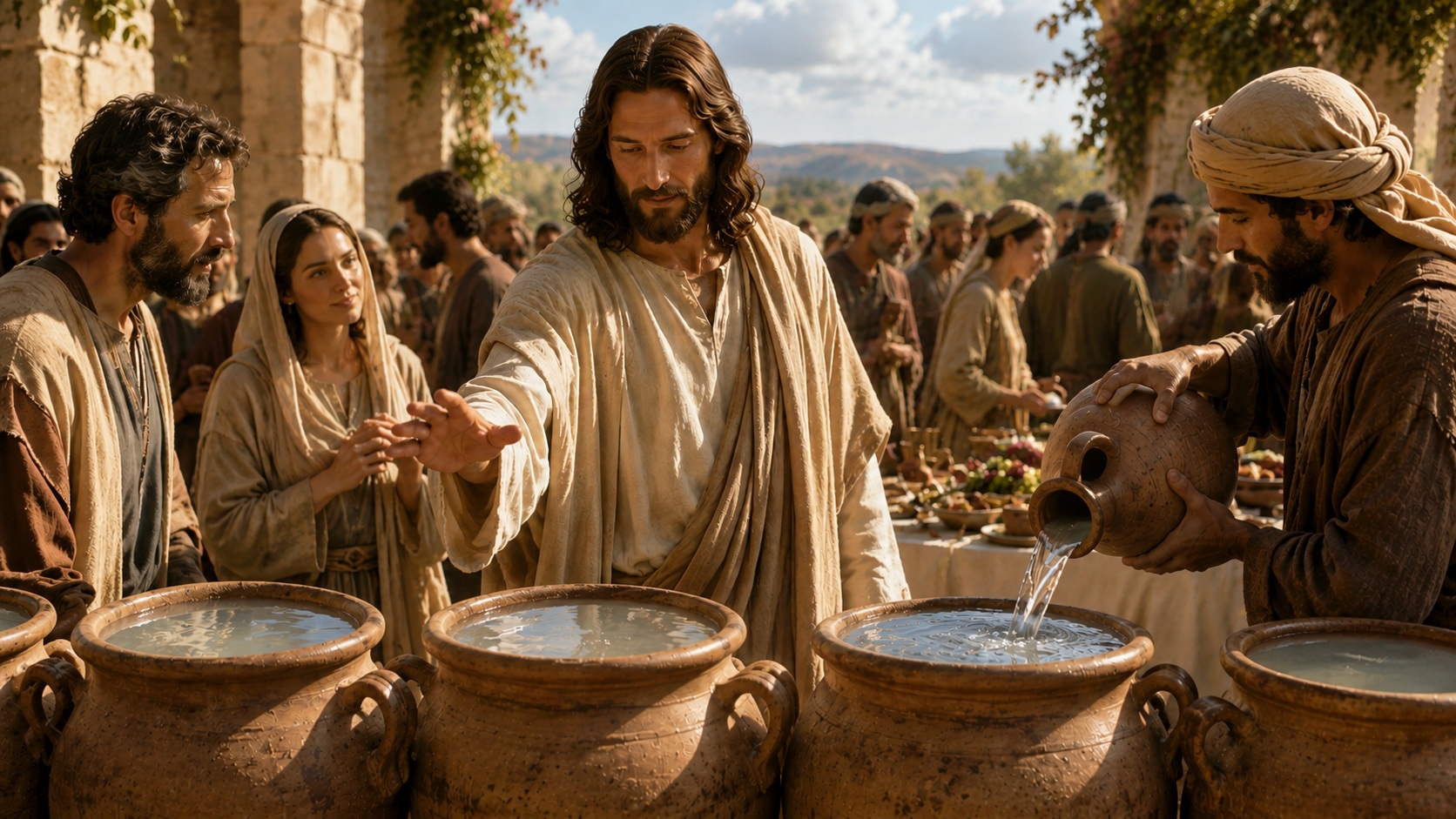
So, this is the third day after he’s talked to Nathaniel. There was a wedding in Cana of Galilee, and the mother of Jesus was there. Now, both Jesus and his disciples were invited to the wedding. And when they ran out of wine, the mother of Jesus said to him, they have no wine. Jesus said to her, My woman, what does your concern have to do with me? My hour has not yet come. His mother said to the servants, whatever he says to you, do it. Now, there once sat there six water pots of stone, according to the manner of the purification of Jews, containing 20 or 30 gallons in each one. Jesus said to these servants, fill the water pots with water. And they filled them to the brim. And he said to them, draw some out now and take it to the master of the feast. And they took it.
And when the master of the feast had tasted the water that had been made into wine and did not know where it had come from, but the servants who had drawn the water they knew, the master of the feast called the bridegroom. And he said to him, Every man at the beginning sets out the good wine, and when the guests have well drunk, then the inferior. You have kept the good wine until now. This beginning of signs, Jesus did in Cana of Galilee and manifested his glory and his disciples believed on him. There’s a lot of stuff here to unpack. I want to first of all talk to you, give you a little literature lesson. Most of you who are more, most of you are more educated than myself. And I mean that sincerely. I did not do well in school, but I’ve done well ever since. Ha. So, a metaphor. A metaphor.
When you have two ideas that are not related probably whatsoever. One is specifically a reality and the other is something that you’re thinking, you’re imagining to kind of bring to the fore. That is a metaphor. The metaphor is the concept, the story, whatever you’re trying to create. That’s called a metaphor. It’s a metaphor because it’s based on something that has already happened. And this metaphor is kind of taking the best of the original story and embellishing it and making it maybe even more simple by the embellishment. It’s an explanation of the first story. But the plan of the metaphor is not to furnish the first story, not to make it look better. But the idea is that the original story is good working material to present this new concept, this new thing that you’re trying to design. The metaphor that I speak of today is the picture in the Scriptures of Jesus who is the groom and the church is the bride. And the whole idea of the Lord God being the husband, the provider, the groom for the people of Israel is richly embedded in the Old Testament.
So it’s not a New Testament concept that Jesus would be known as the groom. And throughout the New Testament, Jesus is identified as the groom. And when you have that idea in your head, that being the metaphor, Jesus and the church, groom and bride, and then you blend that in with this story in your mind, this story really takes on some beautiful concepts that should be a source of blessing. First of all, I have talked at great length about the Jewish wedding. You know from my preaching that I’m enthralled with the whole idea of what a Jewish wedding would take place, what it would look like where the father and the son, first of all, approach the father and the mother of the potential bride and they make some kind of an agreement. And a price has to be paid by the prospective groom. It’s called a dowry and he literally has to pay off the father of their wife because the father put such a huge price on her that it takes him the rest of his life to pay for her. She better be good.
So there’s a dowry involved where he’s purchasing her. And the amount of money that he can come up with to pay for her is an indication of how well he’ll be able to look after her because the father of the bride, he wants to make sure his girl is going to be well cared for. Okay? So the price has some indication of her value and a significant indication of how well this young man is going to be able to look after her.
Once they have made an agreement, they seal it with the drinking of wine. That’s where it’s sealed. Then the groom goes home to his father’s house and there he adds another piece onto the house. Jesus said, I go to prepare. He’s the groom. I go to prepare a place for you that where I am, you may be also. The groom goes and prepares a place and it takes him at least a year. Now, he might be able to do it in a shorter time but then that would be grievous in the eyes of everyone. People would say, he did it in six months, must have been a prefab job. I bet the drywall job is pathetic. So he would take a year even if it didn’t take a full year because that makes it look good. When he has completed it, his father will acknowledge it because you see, the addition to the house really is a reflection on the father’s life too.
So it’s got to be done right. It’s got to match the house, color wise, structure, whatever. And so it’s the father’s determination. Yes, your job is done. Go and get your bride. Jesus said, no man knows the day or the hour when I will come for my bride. Only the father knows. I go to repair a place for you and when that house is done, the father will wink at me and say, go get your bride and I’m coming with a trumpet. And when in the Jewish wedding, after the year has been finished and he’s going to go and get his bride, they blow a trumpet. They’ll blow the shofar. It’s a horn off of a, it’s a two horned animal and all of a sudden it only has one horn. And so they blow this horn and that’s the signal and it’ll be late in the evening and everybody rushes out with the bride and it’s going to be a wonderful thing.
Now, that’s where the celebration actually begins. That’s where the celebration begins because the bride and the groom go to the father’s house and the groom says to everybody, shut your eyes and go away. He takes her into the new part of the house and you know. And then when they come out of the room, they don’t stay in there for very long. I don’t understand that. They come out of the room and everybody has a celebration and they drink wine. Sorry, they drink wine and they eat food for up to 10 days. This is the greatest moment in a couple’s life. The marriage. It’s a covenant. It’s so special. It’s so significant.
And all the guests who were invited to come to it, they are evaluating the father of the bride, the father of the groom and they’re especially evaluating the groom himself. What kind of food? How much food? What is the value of the wine? And they hadn’t better run out. Because you see, if they run out of food or they run out of wine, especially wine, especially wine was the, it was the capstone of the banquet. And we don’t understand this in our thought process. We don’t understand this. But wine was the most important thing and there had to be sufficient of it. Now, just to kind of soften up your feelings about the wine business, in that part of the world, the water was not trustworthy. If you just drank the water straight out, you’re probably gonna get sick and you might even perish. They didn’t have a filtering system.
They didn’t have all of the wonderful things that we have now. But alcohol, all the fruit of that country, if processed in a proper fashion, it turns to an alcohol and it would be quite strong, of course. Now, they could take the local water and add it to the wine undiluted. And in fact, this is how the average household functioned. They drank diluted wine. It was diluted with water because the alcohol in itself would get rid of the problems. So 10 day function, everything’s going well. Mary and Jesus are there. We don’t know what day this is of this celebration. It could have, but not necessarily did it go 10 days. And so here they are. And Mary comes to Jesus and she says, they have no wine.
How was it that she noticed this? And how was it that she was even concerned about the same? That just tells me, just in a small sense, somehow she had knowledge and somehow she felt responsible, if not just out of courtesy, out of love for the groom and the bride. We don’t know what motivated her, but she went to Jesus. Now, what did she expect Jesus to do? Don’t jump ahead of this story. He has not performed any miracles according to Scripture. The last words of this portion, of this chapter say, this was the first miracle. This was the first, and in some translations, and I like it even better, rather than the first miracle, this was the first sign. It was a sign. And because of this sign, this miraculous sign, where everybody became aware that the water had been made into wine, the creator was among them, and in that moment, see the chapters before, Jesus is choosing his disciples, follow me. And they had heard about his teaching.
They heard about his teaching and they thought, I’d love to learn under this man. But they weren’t ready for this, where Jesus turns the water into wine and it concludes, and after this, his disciples believed in him. That was the beginning of their belief system in him. So interesting that she takes this thing to heart and she says, they’ve run out of wine. And Jesus replies to her in a way that I’m not allowed to talk to my wife this way. What has this got to do with me? That sounds kind of rude. But it was an alarm system. Remember about, uh, remember about 20 years before this, when Jesus was 12, he went with them to the Passover celebration in Jerusalem. Then when they were heading home, suddenly they realized Jesus isn’t with them. And so they go back to Jerusalem and they look and they find him. And here are the words of Mary.
Your father and I have been worried about you. You don’t have to read anything into that. It’s very clear. Your father and I. How does Jesus respond? He responds to your father and I. He responds to my father.
I have to be about my father’s business. I’m not worried about your business anymore, Mary. I have to deal with my father’s business. Joseph was being set aside in that moment. It was Jesus’ announcement.
A change is about to come. Here’s the next change. Mary comes to her son. The oldest in the family. Why didn’t she go to Joseph? It’s believed by all Bible scholars. Joseph had passed away by now. He was a very mature man when he married her. And that was normal in those days. Normal. And so it’s believed that he passed away. Now Jesus had brothers.
The Catholic Church doesn’t believe that. But they need to read this book. Jesus had brothers. He was the oldest. So when you’re the oldest son, you automatically have to take the place of daddy. In some way, structural, in the home. You have to look after your mother. Mary had to look after the children and so on. So it’s now normal that she went to, of her son, she went to Jesus. And she said, I’m fretting. Is there anything that we can come up with? She might have even said, let’s form a little committee and figure this thing out.
Jesus, they’ve run out of wine. And Jesus says, Woman, what has that got to do with me? He doesn’t call her mother. He calls her woman. He’s not being rude there. Because through the Scriptures, Jesus will often address a feminine person with, Woman, where are your accusers? You remember that. So he’s not being rude to her. But he is pushing her aside. He’s sounding the alarm. He’s saying, a change is about to come. And she doesn’t realize that that change is literally taking place because of this wedding.
This wedding is a set up. The Lord Father did not get this coming sideways. He didn’t see it. This was in God’s significant plan. Woman, you and I are no longer related. This has nothing to do with our relationship. He’s about to give the first sign of his Messiahship. The working of a miracle. Just back to the wine again for the moment. It was common that people would drink the wine. I just want to put it out there. And Pentecostals don’t believe that.
But that’s okay. So the metaphor is going to start to appear here very soon. Again, just a metaphor. You’ve heard this. Memories are like fireflies flickering in the darkness. There’s the workmanship for, that’s a metaphor. Taking something we’ve all seen, fireflies, and then making it into something else. The silence was as suffocating as a blanket. The beginning of a wonderful story. The classroom was like a zoo this morning. The makings of a great metaphoric story. In this situation, a wedding is taking place, and Jesus is going to bring out his groomship and the church’s brideship through this moment.
So this profound imagery of God, Jesus being the groom, and the customs that go with the Jewish wedding all start to play. Isaiah chapter 4 and verse 54 and verse 5. The prophet says, For your husband is your maker. The Lord of hosts is his name. Did the Jewish people back then understand the significance and the gravity of this saying? We have no reason to think that they caught the whole gravity of it. But the Lord, through all the prophetic words of the Old Testament, was laying the ground for the New Testament. Similarly, in Hosea chapter 2, 19-20, God promises Israel this, I will betroth you to me. A betrothal is a promise. I’m going to promise you to me. The father is promising the bride to the son Jesus. I will betroth you to me forever.
I will betroth you in righteousness and justice, in loving devotion and compassion. So these scriptures in the Old Testament establish the whole concept of Jesus is the groom and we are his bride. Now, there are water pots there where when she says to Jesus, we’ve got a problem, and he said, what have I got to do with you? Number one, she was not pushed away by what he said. So we should not get upset by how he responded to her. And number two, she was not discouraged in thinking Jesus will come up with a plan. She seemed to know what he was going to do. She turns to these servants and says, see those water pots? Draw some water and fill them to the brim. Fill them to the brim. We need to understand what those water pots represent. They were for purification.
Purification was second to nothing in Jewish history. They washed everything and they washed themselves endlessly. Every house had water pots and they were there for purification. Before you did anything, before you went to the house of the Lord, you would stop at a purification spot on your way to the temple. If you’re going to go in the temple, and you would either wash your hands and maybe your face, or you would be baptized. You would plunge yourself into the pool. There were many pools. You’ve heard of the Pool of Siloam. It was near the temple. It was for people to go and cleanse themselves because they’re going to present themselves to the Lord. They would not get rid of their sin, but in washing themselves, they were acknowledging, I am a sinner. And so the purification process was ultimately important.
You wash your hands before you ate your meal. You wash your hands after you ate the meal. You wash your hands before you went to the house of the Lord. Anybody handling the Word of God had to wash their hands before they touched it. You had to wash and wash and wash and wash. Washing was a part of life. The little children, that was the first thing they were taught was the hygiene. Washing, washing, washing because we’re sinful. And so the washing was a reminder before I’m going to the house of the Lord. A psalm comes to mind. Who shall ascend unto the hill of the Lord? He that has clean hearts, clean hands, and pure hearts.
There it is in the psalm. Who’s allowed to go unto the hill of the Lord? He that has clean hands and a pure heart. Clean on the outside, clean on the inside. That’s who’s allowed. So the purification process was extra, extra important in the Old Testament and the people must have got weary of it all. Washing, washing, washing. The priest before he went into the tabernacle, into the Holy of Holy, I think he washed with a Brillo pad. Like he had to be extra, extra clean. He washed himself until he was raw. Because if he went into the presence of the Lord and he wasn’t physically purified, God would kill him on the spot. Purification was so important.
And Jesus uses the water pots to show the first sign of his messiahship. Fill the pots with water. The water in the pots was an indication of purification. What Jesus was signifying to everyone at that wonderful gathering was this. And of course they didn’t catch it on, but we’re catching on to it.
And it was very important in the book of Acts and going forward as the apostles were teaching the people, they would rehearse this story and say, remember he used the water pots? Remember that story? Remember?
Because Jesus in utilizing the water pots was saying, what you’re always trying to do, what you’re always trying to do, I will do for you. When they drew the water and they brought it, filled the water pots, then she told, then Jesus said, now serve the people. And so the servants had to be just, when did the water turn into wine? I have an idea that it turned into wine as they served it.
Now, you know, I’ve traveled extensively and I preach, I would preach, but when you people were thinking about me coming to be your preacher, I was in the bush work, I was in the bush of Kenya, no running water, no electricity, and I was preaching from eight in the morning until 5. 30 at night, nonstop. Well, stop for a drink of water and I never knew where that came from. What am I trying to say? Did I preach a fresh sermon every time? When I was in Bible college, I remember announcing to the guys, anybody who preaches a sermon a second time needs his head read. How come you can’t get a new sermon every time? I had no idea what I was talking about. Your favorite song, how come you listen to it again? And again and again. It’s your favorite. It’s your favorite.
It means something. You get something out of it. A sermon that’s not worth preaching twice shouldn’t be preached the first time. Hello. So as I would go and I would preach for like ten hours straight, of course I had a bag of sermons. And in that bag there was this one sermon which I have not yet preached here. And here’s what I call it. A word, a work, a miracle to the little lady who was starving to death and said I’m going to make a little food for my son and myself and then we’re going to die. The prophet said do something first. He gave her a work to do. He gave her a word followed by what she had to do. And there was a miracle.
Jesus made some mud and stuck it in somebody’s eye and said go down to the water and wash it out. The man went down. If he’d refused to go down and said that’s dumb, he never would have been healed. But the man went down and he washed his eye. He was given a word. He performed the work and God worked a miracle. Fill the water pots. There’s going to be a miracle. Draw the water out. But it’s just water. Draw the water out. And as I fed it to the people, the man who was in charge said everybody else feeds the crowd diluted, diluted wine to make sure they don’t run out.
But you sir, you serve the best wine at the end. A word. A work. A miracle. That principle should be a part of my life and yours every day that we live. You read the word and you get convicted of something and you better do the work of it because God will work a miracle. Someone sick among you, call for the elders of the church anoint them with oil. We had a word. We performed the work and we leave the miracle to God. There’s always a word. Be sure your sins will find you out. Just as I am without one plea I come to you O Lamb of God.
A word. It’s throughout the entire book. Look and live. Old Testament. Strike the rock. It’s all there from beginning to end. A word. A work. And the miracle. The servant served. And what happened? Water had been turned into wine.
You see, Jesus, this got so many layers to it. Jesus cared about that groom and the bride. If the wine was running out and if that problem had not been solved that marriage was sullied in the eyes of the communities for the rest of their lives. Because you see, that would be the worst thing that you could do. You were proving that you were not able to support your bride. You were proving that the promises that you made that first time when you arrived at that virgin’s house and said, I want to marry your daughter. And yes, I can sustain. And if you can’t look after the very first banquet, what good are you going forward? Just see the gravity of it. I want to point something else out as well. These people until this moment were having a blast. I mean, seven days of singing and dancing.
Who knows what kind of party it was. Jesus attended a party. And the party was going sideways and Jesus was there and Jesus made sure that the party rocked on. He’s not against party. I believe that life is to be a party. That’s why I love to make people laugh. And that’s because I want people to have a party here and there. I never stop. I was with Tom and Tom just continuously shook his head with me the way I carried on with waitresses and whatever. Because I just carry on. I love to make people laugh. That is just a momentary party.
Jesus made sure that the party did not go south. Now the words that he said have incredible gravity. My hour has not yet come. There are so many layers to this. My hour for dying on the cross has not yet come. That’s okay. But I see something else. He’s at a wedding. His whole purpose is that he would be the groom and that the people would be his bride. She comes to him and says, this is an important wedding. You should do something. And he says, this is not my wedding.
He’s not slapping her down. He’s making a point. This is not my wedding. I think the majority of people in churches this morning don’t get most of it. They attend church because mommy and daddy did and grandpa did. They’re like people who vote liberal. My father voted liberal. My mother voted liberal. I’m in a wonderful place. My dad voted conservative. My mom voted liberal. He would say, when people say, are you going to go to the polls?
He’d say, what’s the point? My wife breaks my ballot. But so many people are in church today because that’s what we do. I shouldn’t tell this one, but I’m going to. I was first dating her like we were just pups, like brand new, brand new. You won’t remember this. Brand new, brand new, brand new. And we spent the afternoon with our friends, George and Bev, rolling around in the car, probably went out to Lake Erie, I don’t know what. And at 6. 30 in the evening, April’s looking at her watch. She says to me, church is starting at seven. I said, yeah.
Well, don’t you think we should be heading to church? I said, maybe we should take tonight off. We’ll just go and have a burger. She got all anxious. We have to be there. Why? Well, my mom and dad will be there and they’ll be looking for me. I said, we’ll deal with that. And so we had this little, it wasn’t a tiff, it was this little stretch. Why do we need to be there? Because it’s Sunday night. We always go to church Sunday night at seven o’clock.
Therefore, we have to go. It wasn’t, I’m anxious to hear what the preacher’s going to say. I want to be there to be a part of the worship. I love to worship the Lord. No, we had to be there because it’s seven o’clock. There are so many people in churches today. It’s 11 o’clock. They showed up. They wear the same tie, the same this, the same that. They’re there. Do they understand that Jesus passionately desires to be the groom with his wife? In my father’s house are many mansions.
I’m going to prepare a room just for you. We miss so many beautiful metaphors. So many beautiful things that are there. When I was a young guy, I never understood all this stuff. I never got any of that. I never heard about the Jewish wedding when I was a young fellow. Maybe the pastor preached on it some Sunday. If he did, he did it in a boring fashion. It never stuck up here. I don’t remember hearing anything about it. I don’t remember the concept, the importance, the value of it. In my father’s house, everybody in his audience, they connected immediately.
My father has a house. Every father has a house. I’m his son. I’ve got to build a room onto it. Everybody knew what that meant. What they didn’t know when Jesus said, who’s his bride? Who is his bride? Only Jesus knew that the people that were there, he was saying unto them, come unto me. Oh, you are weary and heavy laden. You’ve been beat up with all kinds of religious malarkey. Do this, do that. Rules and regulations.
He was saying, marriage is not composed of rules and regulations. It’s about love. It’s about compassion. It’s about caring. We miss all of these beautiful, beautiful things. This was the first sign of what was about to come. Pastor, I think you’re a little off the base. Like, it’s a little much. Wait a minute, wait a minute. Revelation chapter 19 and verse 7. Let us be glad and let us rejoice. Praise the Lord.
No. Let us rejoice. Let us be glad. And let’s give him glory for the marriage of the lamb has come. And his wife has made herself ready. Pastor, you get a little too excited. No, this stuff. This is not a party. This is not a club. This is not even religion. This is compatibility with the master. The man in the garden was told, this isn’t going to work for you.
I have a plan. We’re going to find a mate for you. A wife. And the very next verse says, So the Lord caused all the animals to pass before him. We’re looking for a wife, Adam. Check these out. And at the end of the day, the Lord says, how did it go? He named all the animals, but not one of them did he call wife. How did it go? It didn’t work, Lord. I don’t know what you’re up to. What was God up to?
The Lord was giving him all the options possible. All the options. All the animals. You say, no, it’s true. He gave him all the options. He frustrated the man beyond end. Two camels went by. Two elephants went by. Two by two by two. And there he stood alone. And he’s got to make up his mind. Who do you want to have as your mate?
He’s totally frustrated. And the Lord says, good. That’s where I wanted you. Then the Lord puts him into a deep sleep. Why couldn’t the Lord just pluck that part out of his body without putting him into sleep? Because this was an actual surgery. The Lord actually opened his body. He bled. And the Lord snapped off what he needed. And then the Lord closed up the wound. And I believe as long as Adam lived, he had a scar. Daddy, what’s the scar for?
I told you. Tell us again. Your mommy came from there. Revelation. John sees Jesus. Revelation 5. I saw him as a lamb who had been slain. Where did the church come from? The angels know. We came out of the sight of Jesus. And when the woman was brought to him, he said yes to the dress. Oh, you do watch YouTube.
He said yes to the bride. He said, my Lord, she’s bone of my bone. Everything about her came out of me. That which was taken from me is now brought back to me. And I embrace that part of myself. Think about that. I embrace that part of myself. That which was taken from me is brought back to me. She’s bone of my bone. She’s flesh of my flesh. The churches that gather today to celebrate LGBTQ, I don’t know how they handle this story. And I don’t know how they handle the beauty of the bride and the groom.
The heavenly groom, his name, his name is Jesus. The bride is she, the woman taken from his side. Jesus was giving them a sign. The very first miracle. Think about this. I’m closing. Think about this. If we were to be a committee and we were given the responsibility, Jesus said, okay, I need some help here. I want to impress some people. I really want to impress them. Now, you know I can work any kind of a miracle. I can open blind eyes, raise the dead.
I can do this, this, this, this. What do you think we should do? Well, let’s do something outlandish. Let’s do something absolutely incredible, mind blowing. He turned water into wine. He gave relief in doing so to the groom who was now not a total failure. He proved the work after a word will produce a miracle. And in that singular moment when he performed this signature, this sign, this miracle, it was the best miracle. It was the best sign. Because the blind eyes would soon belong to a corpse. Everybody Jesus healed died. All those miracles were for a time.
But when Jesus performed this beautiful sign, it was showing an eternal principle. The Lord says, I’ve chosen you to be my bride. Christianity is a love story. It’s a love story. We are his bride. That’s something to celebrate. Now, before we leave this house, if you’re a visitor, you just have to get used to this. We’re going to pray over you before you go. Get nervous. It’s a simple prayer. And you’ve heard it many times. In fact, you might have used these words before.
But maybe you didn’t know the gravity of it. These words are, my prayer is, God bless you. I say it multiple times all week. To the waiters. The person at the grocery store. Everybody that I encounter. And you wouldn’t believe the response I get. It’s incredible. People actually like it. Nobody has said, don’t say that to me. But when we say that here, we’re saying it with gravity. People today are going to shake Pastor Peter’s hand.
And Doreen’s. And when they say, God bless you. By golly, they mean it at the core. That’s what’s so beautiful about God bless you. Not have a good day. No. God bless you. Had somebody call. And they’re probably watching now. We’re about to close. I love to close. I’m good at it, right?
They’ve never been here. They’re here with us on Sundays. And they watch us. And I had a phone call this week. And this fellow said, I’ve heard the sermon. But I want to hear it again. Tell me the root of that prayer. God bless you. We got to the end of our conversation. He said, Pastor David. This is my prayer for you today. My goodness.
This is how he put it. Whatever you’re going through, he had no idea. I’ve had some burdens lately that I’m not at liberty to share with you. Heavy, heavy, heavy, heavy burdens. Heavy. It made me cry. Dear God, I need help. And he said, not God bless you. But my friend on the telephone from far from here said. My prayer for you today, Pastor David, is that Jesus will kneel down where you are right now. And embrace you and ensure you he’s going to take care of you. I hung up the phone weeping.
I was so blessed by that tiny prayer. Filled with compassion and love and appreciation. So if you’re visiting today, somebody is going to say, God bless you. And they mean, my prayer is that whatever you’re going through. The Lord will kneel down with you right where you are. And he will hold you. And he’ll say some wonderful things to your heart. Are you listening to him?
So my prayer is, God bless you.
And have a good day.