

Gracious Father, thank you for allowing us to enjoy your presence. You said where two or three are gathered together in my name, I’m in their midst. So I thank you, Lord God, that you are among us this morning.
I was a little bit under the weather. We all go through that by times. And it’s good to see you all this morning. And there’s people on the road. People are doing various things. And I’m glad that they’re able to go. I just hope they’re able to find their way back. Gracious Father, thank you for allowing us to enjoy your presence. You said where two or three are gathered together in my name, I’m in their midst. So I thank you, Lord God, that you are among us this morning. And for those who are not here because they’ve been laid aside due to illness, we just pray that your strength, your healing virtue will move in their direction. We pray for our good friend, Peter Cuke, that you will strengthen him, heal him, completely heal him. And for Mike Howard, who’s recovering from leg surgery, and for my wife this morning, who’s troubled this morning with a variety of challenges.
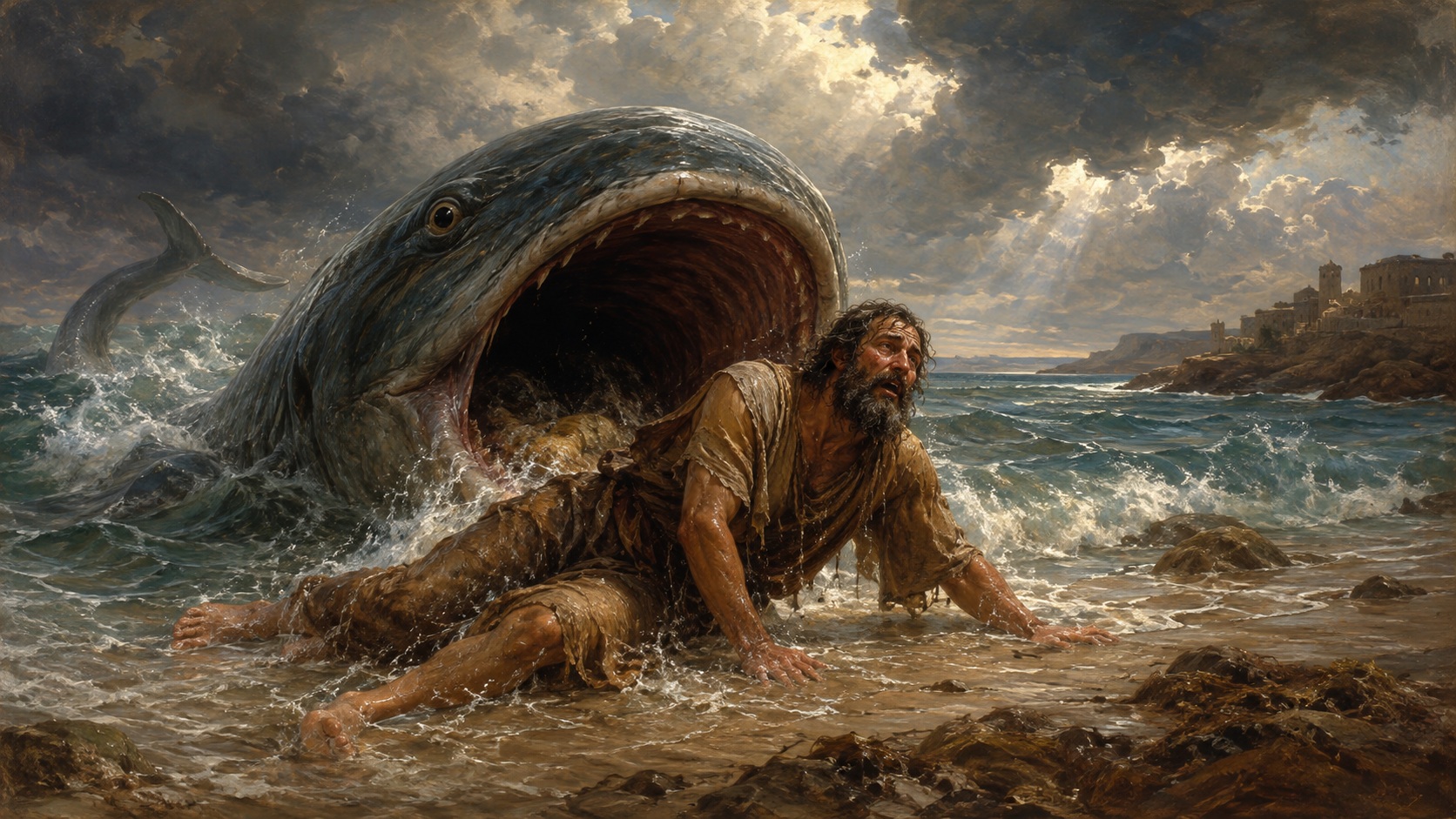
And for others, but too numerous to name, many they are. We just lift them all before you. You know them by name. And we’ll give you the praise and the honor and the glory in Jesus’ name. And everyone would say amen. If I were to say to you, two wheels, you’ve seen this game played. Somebody says, I’m going to say a word and I want you to blurt out the first word that comes to your mind. You don’t have to speak it out, it’s okay. But if I were to say to you, two wheels, you might say bicycle. I might say, I used to say motorcycle. But now if you have to say three wheels, I’d say training wheels. If I were to use another word, like mashed potato, if I were to say Jonah, you’d say whale. Yeah, that’s where I want to go this morning with my message.
I want you to know that the book called Jonah is not about a whale. Now that’s a cute story. That’s cute. And in Sunday school, that’s what we teach the children. Unfortunately, we’re not children. That’s long before us, long ago. So we need to look at the book of Jonah with theological eyes. We want to know what the book of Jonah is about. And I have good news, I’m going to tell you. First of all, I want to read the scripture that I’m going to be speaking primarily about this morning. I believe I’ll be talking to you about this Jonah for a little bit besides today. So the first chapter begins in this way. Now the word of the Lord came to Jonah, the son of Amittai, saying, Arise, go to Nineveh, that great city, and cry out against it, for their wickedness has come up before me.
But Jonah arose to flee to Tarshish, that’s Spain. He fled to Spain from the presence of the Lord. He went down to Joppa, and he found a ship going to Spain. So he paid the fare, and he went down into it to go with them to Tarshish from the presence of the Lord. The book of Jonah is not about a man and a fish. It’s about repentance and restoration because of God’s mercy and grace. That’s what the book of Jonah is about. And that’s what I want to pursue with you today, and the Lord willing, somewhat besides that.
So we’re going to be talking about the prophet’s repentance and God’s readiness to forgive. I can’t go into it today, but I want to take some great length and go into why he didn’t want to go to Nineveh. I’ll tell you this much, Nineveh was one of the most predominant, if not the largest, city in the world at that time. It was certainly the most powerful, it was certainly the richest, and Nineveh was the capital city of the most powerful army in the world at the time. And Nineveh had already been promised destruction by Amos before Jonah came along, and by Nahum also before Jonah came along.
I’ll quickly speed ahead and remind you that the people of Nineveh did surrender to the warning that came from Jonah. They did repent, but about 700 years later, give or take a hundred years, they had backslidden and they went ahead and they went after Israel. So we want to talk about a prophet’s repentance and God’s readiness to forgive. Now it’s so interesting to me that the story of Jonah and the whale, like it’s possible you could this morning have gone into the little classroom across the hall and the teacher might have said, today we’re going to talk about Jonah and the whale. Such an instance happened some years ago when we were working with a pastor in the city of Hamilton at Bethel, and April was over, she was overseeing several classes all within the age of, I think it was four and five or something like.
And so she took one of those pods of classes and said to a little table of boys, today we’re going to talk about Jonah and the whale. And one of the little fellows spoke up and said, I already know that one, can we hear another story today? Because you see, when we dilute a story down to a simple title, Jonah and the whale, we’ve missed everything. And so many children learn about Jonah and the whale in its cute perspective. It’s a cute idea that a fish swallows a man. I got news for you, April told me just yesterday afternoon, she said, where are you going with this? I said, I’m going to tell the people what happened to Jonah when the whale swallowed him. And as I began to tell her the digestive tracting of the whale, my wife said, please don’t tell them that.
It’s not a pretty story, folks. It’s not cute at all. It’s an ugly story with a pretty good ending. All four chapters of the book of Jonah are celebrated and read in an afternoon service every year by every Jewish synagogue. The day that they do so is called Yom Kippur. The original wording that we would identify with is the Day of Atonement. So once a year, the Jewish people celebrate repentance and God’s likelihood to reconcile God’s readiness to forgive, God’s mercy and grace. They take a whole weekend to talk about it, preach about it, read about it. To the Jewish people today in the synagogues, this book of Jonah is not about a whale. It’s about a prophet who needed to repent of his wayward. He was a man of God. He needed to repent. But the good news is that God was ready to forgive.
The troubling news, which we will discover as we go on the next week and maybe a week after that, is that the forgiveness that Jonah enjoyed, he didn’t want the people of Nineveh to enjoy that. Why? We’re going to get there. Repentance and God’s divine mercy. The Day of Atonement. So, it’s really about repentance and grace for Jonah and for Nineveh. For Jonah, he needed to repent because he was failing God miserably. And for Nineveh, they needed to repent because their nation was going to be totally destroyed. Nineveh was a big city. But I was surprised as I started digging deeper into this. I’m familiar with a country called Syria. You’re familiar with that. It’s been in the news the last few years.
There, I think the president’s name was Assad. He tried to murder everybody in his city with a poisonous gas. He was kind of a happy-go-lucky fellow. Syria. But then I’ve always read this word in the Old Testament, Assyria. And I’ve never taken the time to kind of say, well, wait, which one is it? Syria or Assyria? Well, they both have validity. Syria is a current city. Assyria was never a city. Assyria was an empire. And it took up most of Iraq, probably all of Iran, a good portion of Turkey, and some deserts, and eventually it actually swallowed up part of Egypt as well. It was a big empire.
And they considered themselves spiritual people. And spiritual people tend to have big feet, and their feet are clumsy. Assyria was a wicked empire because it conquered every nation, everywhere that it went, and it never took the people captive. It slaughtered them. But in the slaughtering process, it was total brutality, decapitations. That sounds familiar, I think. ISIS and all of these wacky followers of a radical religion, we’re used to that kind of stuff. And that’s where it all comes from, is that side of the world. And so God saw this as wickedness. And Jonah was also aware of the fact that God had pronounced judgment through Nahum and through Amos, but now God was saying to Jonah, but I’m going to give them a chance. And Jonah did not like giving them a chance. So what did he do? He acted like his forefathers, Adam and Eve.
What did they do in the cool of the evening? They hid. They ran from the presence of the Lord. And why? Because they didn’t feel conviction, they felt condemnation. Did you ever weigh up what those two words mean? Condemnation is a recognition that I’m guilty of something, and condemnation would cause me to withdraw, to stop reconciling with the situation, to go into a state of denial, and then begin to cower back because I know that I know that I know that I’m wrong, and I feel like I’m under a guillotine. I feel condemned, I feel I’m finished, I feel it’s over. But conviction is entirely different. Condemnation comes from the father of lies. The word of God in the New Testament calls the devil the accuser of the brethren. The devil will accuse you. And if you listen to him, you’ll feel condemned.
There’s a beautiful verse written by the Apostle Paul. There is now no condemnation to them who are in Christ Jesus, who do not respond to condemnation, who do not respond to the dealings, the wisdom, the stupidity, the longings of the flesh. There’s no condemnation if you obey the Spirit and walk with the Lord. Conviction, conviction is the other word. Conviction is an understanding I have failed. I’m empty, I’m like a plowed field. There’s nothing growing around me, I’m in desperate trouble. Conviction is the working of the Spirit that convinces you to stop being in denial, but to stand up and be accountable and to respond to the Holy Spirit. Conviction draws you to the Lord and you discover His mercy and His grace. And you discover you don’t have to live in condemnation. You don’t have to walk around looking at the ground, but you can walk with your head held high because now you are the sons of God and it does not yet occur to you the things that God has prepared because He loves you and because you have learned to love Him. Adam and Eve felt condemnation. No wonder they listened to the devil the whole way.
And what they do do, they ran and they hid as though God wouldn’t be able to find them. It wasn’t a game of hide and seek. It was the only thing they knew to do. They felt withered. They had betrayed themselves. They had betrayed God. They had been disobedient.
That they declared their independence and they forfeited their love for Him. But what did the Lord do? He came and He called out and said, where are you? He wasn’t playing their game. He wanted them to admit, here we are. Why are you hiding there?
Well, Lord, it’s a long story. Condemnation. Well, Nineveh was living under condemnation. They were about to get destroyed. So Jonah’s challenge, he was privileged to experience God’s grace where he called out for it. Well, we think he called out for it in the belly of the whale, but we’ll deal with that a little bit later. But he was troubled very much with the fact that if he followed through to God’s pleasure, something was going to happen to all the Assyrians that he didn’t think they were worthy of. There’s a process whereby a person gets that divine mercy. It’s called repentance. It’s called repentance. Now churches worldwide have negated that word and they don’t want to talk about it. It’s so easy to get saved in churches today. Well, you can get your child saved just by taking them forward in a service and having the priest sprinkle a little bit of water on them and they don’t have to repent.
They’re forgiven like, it’s kind of like Joe Biden, you know, he got a pass for himself and for the snake who gave us the injection thing. He gave that guy, as long as you live, you’ll never get accused of anything. All the rotten things you did, the lies, the millions of people who died, you’ll never have to pay for that. So that, in the gospel circle, a book was written by a famous preacher some years ago. His name doesn’t come to me right now, it just escaped me, but he was on every day on the radio. I used to listen to him frequently, he was a Baptist, and he wrote a book called Cheap Grace, Cheap Grace. We sing the song, grace, grace, marvelous grace, wonderful grace. And it is, it’s wonderful grace. But grace and mercy is contingent upon these words. Acts chapter 2, Peter’s sermon, the respond of thousands. You men of God, what shall we do? He did not say get baptized. He said, repent and be baptized.
Cheap Grace would say, get baptized. Constantine believed that Cheap Grace. He decided that Christianity was the way for him to rule his entire empire. Instead of using spears and arrows and swords, he decided that he would work out a religious package that hopefully everybody could assume and respond to. When it came to the Italians, when it came to them, he had a challenge there because they had, they had already had the Roman Empire bringing all kinds of cheap religious jargon from all over the world. They brought what was called the sun God, Ra from Egypt, and they were worshiping the sun God. So when Constantine came and said, okay, we’re going to set up the kingdom here and Rome is going to respond to me. And by the way, Christianity is going to be the capstone of religion. Oh, I know that you worship the sun God. He actually blended the sun God in with Catholicism and the sun God is still there. I was in Rome about four years ago and standing right outside that cathedral, that marvelous cathedral is a huge, it’s called an obelisk. I don’t know how they ever got it there. The thing weighs megatons.
It stands high in the sky and on the very top of it is Ra, the sun God, celebrated right outside the Pope’s house. Cheap grace mixes up any kind of religious jargon that you want to work with and says, it’s a smorgasbord, you get whatever you want. Cheap grace is cheap Christianity. It’s a hundred miles wide and it’s a quarter of an inch thick. Cheap grace. Why do I bring that up? Well, because the man, the prophet needed to repent of his sin. God was not going to forgive him if he stayed in Spain.
God was not going to, no, no, you’ve got to leave Spain and you’ve got to go back past Joppa where you boarded the ship, past Nazareth is the town nearest to where you were raised and keep on going. When he had to repent of his disobedience to God, over in Tarsus where a big fish chucked him up, he was 2,500 miles from Nineveh. He fled from the presence of the Lord, 2,500 miles will do it, 2,500 miles won’t do it. The Psalmist said, if I make my bed in hell, I can’t escape your sight. If I turn into an eagle and fly high in the sky, if I can board some kind of a spaceship and set my house up on Mars, I can’t escape your gaze.
So Jonah knew that he could not escape from the presence of God because God is everywhere. So why did he do this? I guess he was hoping that the Lord would say, well, you’ve messed it all up, I’ll get somebody else. Jonah was willing to let the Lord call another prophet because Jonah did not want to be responsible for letting the Ninevites off the hook. He wanted them to die, those dirty Gentiles, bite them in the back, kill them Lord. The profession of faith is not just, have you professed, are you walking with, well, I was baptized, I was baptized. Kids are baptized in a kid’s camp, they’ll run a youth camp, a kid’s camp. The kids are all together in one place, they’re far away from the swings and the teeter-totters, they’re captivated for a whole week. The gospel is shared, the gospel is shared, the gospel is shared, and usually, I’ve been a part of this on the last day when they have a chapel service, they’ll throw out the net, you’ve heard us talk about Jesus all week, are you ready to give your heart to Jesus? Yes, I’m ready. Well, come forward and we’ll pray a little prayer, dear Jesus, I’m sorry for my sin, write my name in your book, amen. You’re done. That’s cheap grace, that’s very cheap, that’s so easy, isn’t it?
And so repentance does not become a way of life because we started off with a cute little story about a whale and a man, like, I’m parallel, I’m comparing it, you start off with a cute little story that you remember, although Jonah, oh yeah, he’s the guy with the fish, you don’t get into the core, you don’t get into the bedrock, you don’t get into the significant part of it, you leave that part out, and so something is missing, desperately missing. So those men on the day of Pentecost cried out, what am I going to do? He said, repent, that means change your mind, change your direction. So, the book of Jonah is four chapters, and you could easily take the four chapters and just say two, the first, chapter one and chapter two, chapter three and chapter four. Chapter one and two is about his first call, his first call. And chapter three and four are about his renewed first call. It’s like a two-act play, and you can read it that way, it’s like a two-act play. Arise, go to Nineveh. But Jonah fled to Tarshish from the presence of the Lord, but he never escaped. And that’s like Adam and Eve, they could not escape, they were trapped. God was going to call them to account. So, go and prophesy, go east, and he fled west. Condemnation, he recognized that he had done wrong.
And so, from the belly, okay, I’m going to skip ahead a couple of weeks, I’m going to tell you, I believe that where Jonah was calling upon God was from the bosom of Abraham. Why do you believe that, Pastor Dave? Well, that’s my conclusion. Now, God could have kept the man totally whole inside the whale. That would have been an incredible miracle in itself. I looked it up, I looked it up. The whale has two tummies, two stomachs. The first stomach has no acid in it, it’s just incredible muscle. And it pounds away at whatever is in there until it breaks it into small parts. Then that material moves into the other stomach where the liver feeds it with acid.
And in about 18 hours, there’s nothing left, you’re just soup. I believe that the moment that he was swallowed, his spirit was separated from his body. The remainder of his body was left inside the whale, and the spirit of Jonah ended up in the bosom of Abraham.
Can you prove that, David? No. I just believe that. I just believe it. That he called out to the Lord from the bosom of Abraham. And I’ve talked to you about what the bosom of Abraham is all about, right? I’ve talked to you about that. It’s not that Abraham has a womb or something, bosom buddies, friends, close to somebody that you revere, the father of our faith, good old Abraham. You’ll be with the comfort of Abraham, you’ll be together with him. And so from the death of Adam to the last person, the last Jewish person that was a godly person but died just before the resurrection of Christ, all those people were in the bosom of Abraham. And when Jesus arose from the dead, he led captivity captive out of the bosom of Abraham. And they went up to be with the Lord. I believe that Jonah had an early resurrection as his body reconstituted was spit out of the mouth of the whale.
I just believe that. You don’t have to recognize that. You don’t have to believe that. An interesting factor that when we experience condemnation, our soul gets ripped and torn up. Your soul is comprised of your mind, your emotion, and your will. And when you experience condemnation, your mind is tormented by the fact you have failed the principles of God. And your emotions are disturbed and you have restless nights. You become irritable even around people that you know. Because you have failed the Lord. And it is affecting your emotional stability. And all of that, your mind confused, your mind is troubled. If only I hadn’t done this. If only I hadn’t done that.
You’re living with the memory of a failure. It affects you emotionally. And then there’s that third part of your triune being, which is your will. And your will becomes bent the wrong way. And you can actually become stubborn in your condemnation. And you begin to, in your own mind, allow your conscience to excuse you. Oh, well God didn’t mean that. You’re actually regurgitating what Satan said to the woman. You don’t really believe that God’s going to punish you like that, do you? The lie is turned into something that’s kind of half positive. No, God’s better than that. No, he wouldn’t put you down like that. So condemnation works, it’s a weird wheel that goes around and around.
But conviction is totally different. Conviction is the Holy Spirit drawing you and wooing you toward the Lord. The Holy Spirit enlightens you with God’s truth. Gives you the understanding that Jesus died on the cross for you. And there’s an opportunity for you to be redeemed because God is righteous. He’s not willing that anyone should perish. And he wants to write your name in the Lamb’s book of life. Or in our case, the Lord just wants to restore, bring into restoration our relationship with him. So he gives you all the reasons why he can take care of you. He can, he’s going to be gracious to you. The story about Noah, totally disobedient, takes off to Spain. Calls out from somewhere in the belly of the whale, swimming around in this soup. Or maybe somewhere down in Abraham’s bosom. God is righteous, God is generous, God is gracious. And so your mind, your emotion, your will under conviction works in your favor. So many of us live with condemnation and we don’t even recognize it that way. We’ve made some mistakes. We said something we shouldn’t have said. We did something we shouldn’t have done.
We can’t unroll it, we can’t unpack it. And how shall I deal with this? If a person tells a lie, they usually have to tell another lie to back up their first lie. You just start going down and downward spiral. Mind, emotion, will, turmoil. But conviction, knowing God’s truth, you shall know the truth and that truth will set you free. You know that truth and that truth will set you free.
There’s no creature, the book of Hebrews says, hidden from his sight. All things are naked and open to the eyes of him to whom we must give an account. Run, Jonah, run! Run! Ignore God. Become totally immoral and irreligious. That’s what so many people do. Or the other thing is run, run, run. No, we become religious and we start reading our Bible more. We start doing things to get God’s approval. So we try to cover up with doing the good things. We try and reconcile. We try and fix it ourselves without just facing the music.
And letting the Lord deal with our heart and our lives. Something occurred to me this week as I was studying, going back, reading all the old theological wizards of the past, especially in the Jewish school. Something occurred to me that hadn’t occurred to me before. You’ve heard this, I’ve heard it. Somebody says, how did you come to that conclusion? How did that ever work out? Well, you know, I was praying about getting a new car. And as I was praying about a car, I just, I want to go totally with the will of the Lord. And I was saying, Lord, I’d like to get a blue car if I can find a blue car. And then I went shopping and can you believe it? I went to this one dealership and there was a blue car. And I thought, that’s got to be the Lord. So I talked to a salesman and I said to the salesman, what can you tell me about the blue car?
And the salesman says, oh, that blue car. You know, it’s been on the lot for 60 days. And the boss pulled me in this morning and said, you’re my best salesman. Prove it today. I want the blue car gone today. And there I am standing a look at the blue car and I’m drooling. And I said, how much, how much, how much? And he says, I can give you $2,000 off. It’s got to be the Lord. I mean, things are just falling into place. This is incredible. I’m driving through the downtown. It’s impossible to get a parking spot.
There’s a meter and the spot’s open. I’ve got a testimony. I got an open meter. The town was jammed. God provided for me a parking meter. Sure he did. Jonah, it says, decides to flee the presence of the Lord. He goes down to the shipwreck. He lives somewhere up around Nazareth. He makes a journey down to Joppa, which is a seaport. And he starts asking around, where’s that ship going? Where’s that ship going? He wants to get as far away from Nineveh as he can get.
He comes along and he says to some sailor, you guys are loading some cargo. Where’s this ship going? Tarshish. Tarshish. That’s in Spain. Yes, it is. Where’s the captain? Let’s see what’s happening here. He finds the captain. This is how it happened. I was there. I was an eyewitness. I was with the CBC.
He finds the captain. He says, sir, this ship is sailing to Spain. Yes, it is. Would you have room for a person to travel along? Well, you’ll have to pay me a little bit for it. Well, how much would that be? Well, usually I would charge you 150 pesos. But you’re kind of a good looking guy. I’ll give it to you for 50 pesos. But when is this ship sailing? In three hours. It’s God. It’s got to be God.
Everything’s falling into place. God’s not nearly as upset with me as I thought that he was. Think about it. Think about it. Think about it. He knew that he was being disobedient. He was trying to run from God. He was wondering how much he’s going to pay for this stupidity. He is acting like Adam and Eve in the garden. He became independent. He disregarded the love compact he had with the Lord God. He was on the run. But he gets down to the shipyard and things start falling into place.
He’s upset with me, but he’s giving me a pass. I’ve wrestled with this one. You know that I try to be transparent with you people as much as I can. So I’m going to tell you my story. It’s not a nice one, okay? I’m not going to look good when I get done here. The general superintendent of Canada came to visit me at the church in London and said, David, of all the evangelical churches in Canada, I just met with the top denominational leaders. Your church is the talk of the nation. How do you feel about that, David? I said, Brother Tatinger, I’m not impressed. David, that’s good news. I said, Brother Tatinger, I don’t think anybody in the PAOC, if what you’re telling me is accurate, nobody out there who thinks David’s a great guy has any idea what I’m going through. I can’t get a day off, sir.
I’m working seven days a week. I’m dealing with a cesspool, sir. When I go home at night, I want to get into a bathtub of tomato juice, of acid. I feel filthy. I said, if I were to tell you the things that I’m hearing in my little counseling sessions in my office, you would say to me, David, how can you live with that? I said, my head’s full of trash. I said, it’s a populous church in this city. I said, every idiot is coming here. They’re all coming here, and they’re all bringing their baggage. I said, I don’t know how much I. . . David, the Lord’s going to look after it.
The Lord’s going to look after it. My mind, my emotions, my will. I can’t tell you the stress I was under. I actually came to the point when I would walk in. You see, I was a good pastor in those days. I worked out of my office. I don’t do that anymore. It’s a dangerous place to be. All these people coming in off the street. Like, I couldn’t handle it. But I would be at my office every morning by about 7 o’clock in the morning. And it was a brand new building. It was only a year old, and we were packed out.
We were in two services already. And, Al, when I would walk into that building on Monday morning, on Tuesday, I hated the smell of that building. How stupid is that? It was brand new. I’m smelling the carpet. But it wasn’t a happy smell for me. But on Sundays, I put on quite a show. I preached my heart out. And people got saved. Every service. Every service. And I’d go home in the afternoon. April found me, more than once, sitting on the sofa in the evening.
After three services that day, she found me on the sofa in our living room. I was crying and sobbing like a fiver. David, what’s wrong? I said, I don’t know. I’m tired. I’m sick of it. I want out. I heard about a conference in Buffalo, New York. You know where that is. And a preacher I’d heard about, Dr. Yonggi Cho. He was pastoring something like a million people. I need to go and learn from him.No. You don’t want to learn how to build a church up to a million. Are you nuts? You can’t manage what’s happening where you are. But I came down here, across the border. And I went into the meetings, and it was incredible. The stories that that man told.
And I thought, how can this man be so successful and so many people following him and whatever? I thought, I don’t want to be successful like that. So my mind was a playground. Okay? Follow this. My mind was a playground.
They took a break in this session and said, get some fresh air. Coffee’s on. Take 45 minutes and come on back, and we’ll go on to the next session. I walked out into the parking lot. And a man who I will not name. But this man was my hero. He had mentored me from my first year out of college. This man would sit in the front. This was a big church in Ontario, and I preached in that pulpit every Sunday. I was so blessed by a senior pastor who wanted to mentor me and help me. He’d sit right in the front row. And when I’d wind up preaching, he’d yell at me. Yes, David, that’s the anointing.
Go, David. Go, David. He was my mentor. He was my hero. And as I’m standing out there amidst all these hundreds of preachers, all of a sudden I heard, David Forrest. I turned, and there was my hero. Had to be 75 years at that time. He came over, and we bear hugged each other. I was so thrilled just to see my hero. He says, David, we need to have a talk. Come on over here. So he got away from everybody, and he said, he said, I believe I have a word for you. I said, what would that be?
He said, I believe the Lord has told me that the People’s Church in Hamilton is going to come open. And you’re the next pastor. I did not say goodbye to him. I turned, and I ran from his grip. I literally abandoned him. He had to think that a wasp had crawled up my pant leg. I don’t know. I just ran. There was a street. I ran across the street, and across the street was a big parking lot, hundreds of cars. Nicholas, I ran between those cars. It was a gravel lot. I dropped on my knees in that gravel, and I screamed, dear Jesus, don’t do this to me.
I can’t handle this. I can’t handle it. Don’t do this. You see, I believe that man because he’s such a man of God, kind of like Jonah. He was a man of God. Peter, the following of Jesus, who denied Jesus the night of his betrayal, he was a man of God. Samson was a man of God. David was a man of God and slinked away with Bathsheba. Men of God are all not always perfect. But this man in my eyes was perfect, you see. He was my mentor. I went home. Oh, I was disturbed.
Then a man showed up from the city of Toronto, a very successful church. Knocked on my door on a Monday morning. His name is going to be disregarded. He came in, and he said, David, I’ve been watching you for years. God’s using you, blah, blah. He just went on and on. I said, sir, sir, please, no. Trust me, I never saw myself as a hero. I saw myself as not a sergeant in the army. I saw myself as a guy fresh out of boot camp. What was I, 32 years of age? I was getting far too much appreciation for my age. And I said, no, that’s not me.
I went to my district superintendent at one point. I sat in his office. He said, David, we’re so proud of you. I said, sir, sir, sir. And I actually wept in his presence. I said, I don’t know what I’m doing there. I preach the gospel, and people get saved. That’s not enough. These people need to be mentored. They need to walk the walk of faith. Sir, I’m not a Bible teacher. I’m a preacher. I said, I think I’m out of my league. He said, David, hang on, hang on, hang on. He said, you know how many preachers would give anything to have what you have?
I said, give it to them. Give it to them. This guy came into my house, and he literally dropped on his knees in my living room. And he started praying out loud. Then he burst into a language that I did not know. And then he came out with, I don’t know how come God speaks in King James Version. Verily I say unto you, you have found favor in my sight. I don’t remember all the wordings. But I have called you to another vineyard. He went on and on and on. Wiped his face.
He’d been crying. He embraced me. He said, David, God’s going to take you to the people’s church. I didn’t want to hear it. I can’t go on to tell you exactly how I ended up at that church. I tried. I mean this. I tried desperately. Here’s a confession. That church today is running two or three thousand people apparently. Good for them. God bless them. I mean that.
I mean that. I mean it. But that congregation that I pastored never knew what I’m going to tell you now. They still don’t know. You don’t tell them. If you tell them, I’ll have to shoot you. The day I walked into that office the first day and was given the keys, I walked in and I sat down not in the pastor’s chair but in the guest’s chair. And for two months, I sat in that chair. I never sat at the desk. I was in the wrong town. I was in the wrong church. If you were to step back and look at all the pieces, you know, Jonah had the money. He could get a place on the ship.
The ship’s leaving in a couple of hours. Must be God. I’m here to issue you a warning. The next time God provides you a parking meter in downtown Grimsby, enjoy it. But don’t tell me your testimony about it because I’m suspicious. I’m suspicious. I’m very, my time, I’m very hesitant now. I’m so hesitant. I will feel like the Lord shows me something about a person’s life or whatever, and I want to speak into their life. You need to know I’m so hesitant that I’m probably guilty of not following through. I’m so afraid that if people trust me, that’s dangerous ground. Pastor said it. It must be true.
Everything I say in this pulpit, weigh it up, honey. Weigh it up. If I’m off, if I’m off guard, don’t come to me about it. I’ll probably rebel. There are people in this church that I rely on. I do. There are people in this church that I really, really trust. I know they love me, and they love me enough to correct me. And I like that. Don’t you decide. Well, I love you too, and I’m going to give you a piece of my mind. You can’t afford that. Jonah was a disobedient prophet.
And he ended up in the belly of a whale. And I think he drowned before he got into the first tummy pocket. You don’t have to believe that. I’m convinced. And I’ll tell you why, just in a word. If you read Jesus in the Gospels, and the Pharisees said, after he’d fed the thousands, raised the dead, opened blind eyes, they had the audacity to say, give us one more sign. He said, I’m giving you the sign, the resurrection of Jonah. Now, I haven’t got time to go into all of that for you today. But when Jonah came out of that whale, it was a resurrection. That’s just a small piece of bread of the message. You’re going to say, well, why are you making such a big deal of it? Because I do. Because I dive deep, and I look, and I savor.
I savor not trying to be clever, but I savor knowing in the word of God. And knowing why those four chapters about Jonah are there. And realizing that what Jonah was guilty of, I have been guilty of. I wasn’t guilty of going to that church, by the way.
I got shanghaied. I got sideswiped. Don’t ask me more. We’ll leave it there. Good people in that church. Good people. But I have, without going into detail, I have at other times run. Run. Run.
Don’t run. Don’t run. Walk into the arms of the Lord. And don’t take little things that come along and say, it must be God. Because look there. Be careful of that. And when somebody says, I have a word for you. That word ought to be a confirmation, not news. Let that sink in. I’m going to say it one more time. If somebody says, I believe I have a word for you. That word for you ought to be confirmation, not news. I’ve got a word for you, Nicholas.
God’s calling you to China. Oh, good. I love rice. It needs to be a confirmation of what God was. God knows your email address. God knows the house you’re living in. God knows. He knows your license. He knows you. And he can talk to you. And let the confirmation be that God shows up and says, there I put my postage stamp. I put my seal on it. That God confirms it for you.
Does that make sense? David, stop it. These people want to go to Swiss Chalet. Don’t go there. It’s closed. You have to go way across the city. You go where you want for lunch. Heavenly Father, if there’s one person in this house that’s running from you, they must be running because they feel condemned. They’re not ready to face the truth. Oh, dear Jesus, they’re running from love. They’re running from acceptance. They’re running from truth. Dear Jesus, I pray for everyone in this house.
The members, the non-members, the visitors, whoever they are. I pray for them, and myself included. God, help us to be honest to God. Honest before the Lord. Search me, oh God, and know my heart. Cleanse me, I pray. Lead me. Keep me away from the path of temptation. Lead me not. Don’t let me go into temptation. But lead me in the paths of righteousness for your name’s sake. Lord, when I find myself in Spain, and I was supposed to be 2,500 miles on the other side of the world. Oh, God, help me to face the truth.
And find my way back into your good grace.
In Jesus’ name, amen.

