
Praise God. You may be comfortably seated. Greetings from Ken Bombay. He wanted to be remembered to you people, and he and I were on the phone yesterday having a chat, and he’s a great guy.
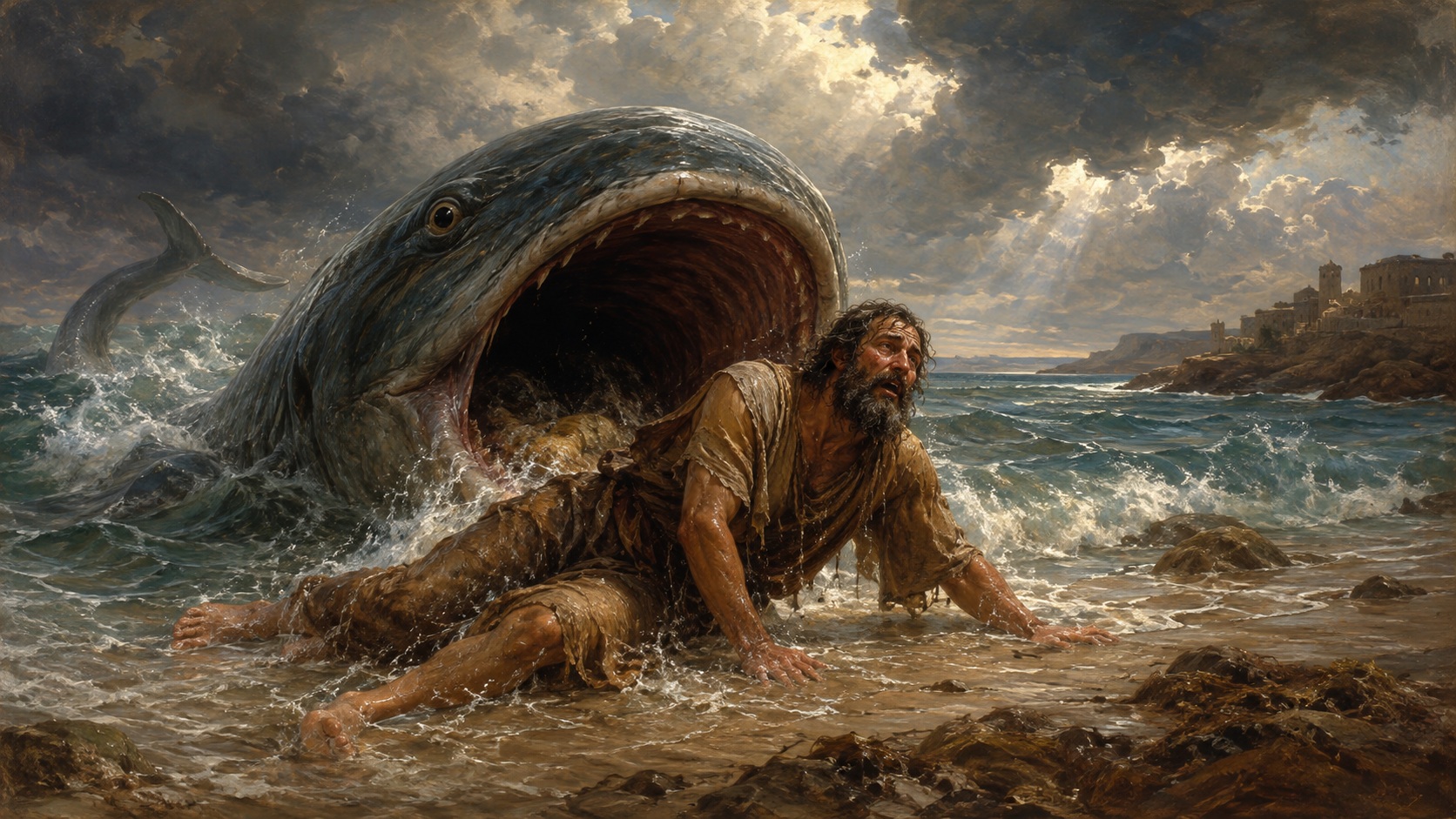
Well, I’m continuing in my deliberations with the story of Jonah and the big fish, and for those of you who weren’t here, just play this little game with me. I’m going to say a word and you think of another word, the word that immediately comes to your mind. You don’t have to say it, just think of it. If I say two wheels, bicycle, mashed potatoes, fried onions, Jonah, whale. Of course, it’s all about Jonah and the whale. The title of my message the last few weeks and ongoing in four chapters of Jonah has nothing to do with a whale. Nothing. The whale was an instrument to get Jonah’s attention and get him to repent of his attitude. The storm that came up against the ship that he was aboard with those pagans, that was an instrument of the Lord.
So, we want to discover more about what these four chapters are about. So, I’m going to adjust the title this morning and say four chapters of Jonah, not about a fish, it’s about the neighbor. The neighbor. Everybody in this room has neighbors. We have brand new neighbors. Again, next door is a rental property and nobody’s ever happier, nobody’s ever happy there for more than 12 months. Doesn’t matter why. But the new couple are an interesting couple indeed. Quite young and she’s a tattoo artist. She always wears shorts. And so, if you wonder what she does for a living, you’ll see it on her legs. I’m just not being rude, I’m just saying. And they’re quite an interesting couple.
Very nice. I supply them with, I had no idea I was planting very hot peppers. I went to this place and I’m looking, I wanted, I like peppers, green peppers, red peppers, yellow, you know, the sweet kind, you know. So, I saw this thing, a little tag and it said orange peppers. And then some other weird Latin name and I said, well, okay, habanero or something, I don’t know. So, I thought, oh good. So, I bought probably three or four of these because I want lots of peppers. And they came up and yeah, there were orange ones. They don’t get very big, but the yellow ones, almost the size of a banana. You bite that thing and if you don’t look like me with no hair, you will have no hair like it will. So, I find out that the people next door, they love peppers. So, I pick the peppers and I share that with them. So, a couple of weeks ago, we had this horrendous storm here and everybody’s basements were flooded and their basement was flooded like everybody else’s.
And in the midst of their worry, about 14 inches of water in their basement, what about the old geezer next door? They came and they knocked on my, now they don’t call me the old geezer, but you can tell when they’re looking at you, they’re thinking. They said, sir, are you okay? I said, yes. And they said, well, we’re worried about you. And I said, that is so kind of you. Are you okay? Well, no, we’re up to our knees in water. I said, you need something. No. I said, so what can I do for you? Nothing. We came to find out, are you okay?
Six months ago, I heard a knock on our door and we have another new neighbor on the other side, a young couple, beautiful young couple with beautiful little blonde kids. And I already knew who they were before they came because I met their mom and dad. Long story. But here, I don’t know how far back it was. It was months ago, heard a knock at the door. I went to the door and here’s this couple and they got one in a stroller and the other little guy is in dad’s arms. And they said, Dave, are you okay? I pinched myself. I said, I think I’m okay. What’s on your mind? Well, we haven’t seen much of you lately. We haven’t seen much activity and so on. And I said, oh, are you worried?
Well, yeah, we’re worried about you. Are you okay? I said, yes, we are. They said, well, we’ll be going then. I said, wait, wait, wait, wait, wait, wait. I said, this is so generous of you like to come and ask, how am I? They said, well, we’re your neighbor. I said, yes, yes, we’re neighbors. Well, we just want to make sure you’re okay. So in a couple of hours time, we make jam. I make jam. I grow all these berries forever and ever. I’ve got berry bushes.
When somebody wants to buy my house, they better like fruit because I grow berries, berries, and berries. So I make this beautiful blackberry jam. And so I took a jar, a big jar, and I went and I knocked on their door and he and she came to the door and a little fellow there looking between their legs up at me. And I said, that little fellow is so cute. I bet he likes jam. And they said, he loves jam. I said, what you did for us a few days ago has just absolutely stirred me to the quick. And I said, to say thank you is something I say at Tim Horton’s just for the coffee. I said, that’s, that’s got no depth for me just to say thank you. We all say thank you for no reason, really, just to be courteous. I said, I’m not trying to be courteous. I’m trying to tell you that you knocking on our door and just asking, are you okay? I said, that’s nothing short of incredible.
And I just want you to know, we appreciate it so much. Now the word of the Lord came to Jonah. What was that all about Dave? You’ll catch on. The word of the Lord came to Jonah, the son of Amittai saying, arise, go to Nineveh, that great city and cry out against it. Their wickedness has come up before me. But Jonah arose to flee from, to flee to Tarshish, which is in Spain. From the presence of the Lord, he went down to Joppa, that’s on the seaside, not far from where he was, found a ship that was on its way to Spain. So he paid the fare and he went down into the ship to go with the ship and the crew that was aboard to Spain from the presence of the Lord. We’re going to deal this morning with neighbors. What’s that got to do with this man? Fasten your seatbelt. He was told to go and speak to a bunch of pagans.
How many were there? Hundreds of thousands, maybe a million plus. Nineveh is the capital city at that time of all of Assyria. Assyria is an empire. And when they decide to wipe out a nation, a country, a tribe, they do so with a vengeance.
And they were known at that time. And so today you can read in the history books about Assyria. There’s never probably been a people on the planet that have been worse than them. Blood thirsty people. They would skin the people alive that they were attacking. And they took the skin of those people and they decorated the walls of their city gates. They did unconscionable things. And I won’t go down the line.
It’s just absolutely sickening to read about what these people did. They were pagans. Of course, they were pagans. They were another race entirely. They had no relationship whatsoever with Abraham, his descendants. These were not descendants of Esau, like the Edomites or whatever, the termites, all of those people. These were another race of people altogether. Totally different culture. Totally different language. And in this man’s mind, Shona’s mind, I’m going to put, I’m just going to say this, I have no way to prove it, but I believe he was afraid to go among them. He was a Jew. He was a Hebrew. He was from another country that they were fixing to go and attack.
They’re going to attack Israel. And eventually they did. But at this time, the Lord says to Jonah, you go when you preach to them and you tell them if they don’t straighten up their act, I’m going to wipe them off the face of the earth. I believe that the man’s heart melted within him. And so he ran the other way. Now about the neighbor, Deuteronomy chapter six and verse five, you shall love the Lord, your God with all your heart, all your soul, and with all your might. Now we already know about the 10 commandments, but Jesus reminds us in the New Testament, he quotes this verse and another verse as well that I’m going to read for you out of Leviticus. He was asked, which is the greatest commandment? And he didn’t quote the first commandment, the second, he didn’t quote any of the 10. He quoted another verse, Deuteronomy six, five, you shall love the Lord, your God with all your heart, all your soul, and with all your might. But then Jesus goes on to now quote another commandment, which is found in Leviticus chapter 19 and verse 18, another commandment. You shall not take vengeance or bear a grudge against the sons of your own people, but you shall love your neighbor as you love yourself. I am the Lord.
So the day came when he was asked, which commandment in your mind is the most important one? They were thinking the 10. And Jesus said, the greatest commandment is you shall love the Lord, your God with all your heart, all your mind, all your strength. And Jesus just goes on and attaches Leviticus another challenge. He says, and the second greatest commandment is you are to love your neighbors as much as you love yourself. Did Jonah know these commandments? You bet your green apples, he knew them. For those of you who’ve been with me here, the journey through the word of God, you might’ve got weary of me talking about how in the local synagogue for the children and for the adults, the teacher often known as a rabbi, or maybe somebody not as cultured, not as a school, but somebody worthy, somebody who was capable would read from the scrolls, read from the scriptures.
They would never comment on the scriptures. I just read to you a couple of verses and now I’m commenting on it, but in the synagogue, and I believe it probably is still the same today, when the word of God is read out loud, no one, including the teacher, the highest teacher in the land, nobody makes a comment on it. You don’t add something to what you just read. You never pause and say, by the way, did you notice this? But then after the teacher has done so, then the teacher sort of changes hats and he moves to one side or the other, and he sits on traditionally what’s known as the seat of Moses.
And in the seat of Moses, this is the place where the one who read the word of God is now equipped to explain to you what he just read to you. And any other thoughts that came to his mind, this would be his commentary. This would be his suggestion. So Jonah as a youngster would have sat in the synagogue and he would have heard the words of the laws of Moses. So everything that I just read to you just a few moments ago, that’s all from Moses. This chair that was on the side was called the chair of Moses. The most important books in the Bible for the Jew, even to this day, are Genesis, Exodus, Leviticus, Numbers, and Deuteronomy. That’s called the Pentateuch, or in their case it’s called the Torah. And by the time Jonah was at the age of 12, if he was any good at all, if he was studious at all, he could print near quote verse by verse all those books. You could ask him a question about anything that was in those books and he wouldn’t even hesitate. It would come out of him like a computer. He knew the word of God backwards, forwards, upside down, and so he knew you shall love the Lord your God with all your heart, all your mind, all your strength, and then jump over to Leviticus and you shall love your neighbor even as you love yourself. He knew those verses.
And so the question that was terrorizing his mind would be this, who’s my neighbor? Not those pagans up in Assyria, they’re not my neighbor. Do we get to pick and choose who is our neighbor? I bring this to your attention today because this country and just about every other free country in the world, I say this kindly, I don’t say rudely, I don’t say this in any kind of a degrading fashion, however, every country that is free right now is being overrun most of the time with migrants who are not interested in letting you know that they’ve heard what’s going on. Just in the last few days, have you heard what’s going on in Spain? They’ve taken over a whole city. The children are being microphoned on the street with a videotape. Little girl, eight years of age, tears running down her cheeks. She said, I’m afraid to go outside, those men are everywhere. There is rapes going on. The stores are being ripped to shreds and things are happening even in our country, not as critical as that, but our country is being infiltrated by a lot of immigration. And it’s going to come to a crisis because so many of the people who come from another country bring their own culture, bring their own religion, and they’re not going to blend in with the rest of us. They have no intention.
They’re not excited about learning our language. They’re not loyal to our country. There’s nothing nationalistic about them, but they’re going to be made very comfortable because our own federal government has declared Canada does not have its own culture and we are not a nationalistic country. We have a bigger heart. We’re here for the whole world. So you, as long as you live, are going to see the pressure, pressure, pressure building. And your children, your grandchildren are also going to face these things. I’m not an alarmist today. I’m talking in reality. So all of a sudden you have brand new neighbors and what are you going to do about that? But it gets deeper than that. It gets deeper. It’s a form of racism that we will respond to if we don’t like what’s going on, but they bring a racist culture and a racist idea with them because they’re coming here to alter us.
So there’s going to be a meeting. There’s going to be a challenge and we have to decide, I would say, as God’s people, how are we going to handle this? How are we going to handle this? Jesus said, love the Lord your God with all your heart, your mind, your strength. Then he said, the second is love your neighbor as yourself. Then he said, there’s no commandment greater than these. Let’s talk about neighbors. Luke 15, the stories are three. A man with a hundred sheep, he loses one. A woman who’s not necessarily a coin collector, but for the sake of helping me through this, we’ll call her a coin collector. There’s a bigger story behind the coins. We’ll leave that for a moment. A man with sheep, a woman with coins, lost one.
And then a father who has two sons. You know the story. The third son, the third story is known as the story of the prodigal son. We all know that story. But here’s a question I have for all of us. A shepherd, a coin collector, and a father. What do they have in common? They have one thing absolutely in common. Each of them has what I will call a treasure. Something ultimately important to them. For the shepherd, it was sheep. For the woman, it was a coin. For the father, it was a son.
What do they have in common? That shepherd was the only shepherd in the world who cared about that lost sheep. Now, Jesus said, shepherds love sheep and shepherds will give their life. They’ll lay their life down. They’ll go out in the middle of the night, face wolves and bears and who knows all kinds of predators just to salvage that sheep. Jesus said so. But what he’s implying is that shepherds don’t sit by a radio waiting for, okay, shepherds, let’s go. We got a problem. Let’s go. It’s night. Bring your flashlight. We’re going to go face the bears. No, no, no, no.
The shepherd will lay his life down for his sheep, not for your sheep. Only one shepherd that night cared about that sheep. That shepherd risked his life to rescue it. The woman, she valued a coin that nobody else on the planet valued. Again, the story about the coin. It was not something you could take to a store and sell. It was more than an antique coin. It was a specially minted coin. It was a family heirloom. There had been 10 of them made and somehow or other, carelessly, she’d lost one. If anybody else had found the coin, they would have said, well, I’m going to do with this. Obviously, it’s pretty. It’s a nice cultural thing.
It’s got things written on. I don’t understand. It’s all about somebody’s family or whatever. It would have been useless to anybody else. She’s the only person that cared about that coin. And the daddy, he loved his son. His son broke his heart. But if he ever tried to talk to anybody else about his son, those people probably would have blurted out something like, if I had a son like that. This daddy was the only daddy on the planet that cared about that son. Now watch this, because Jesus is the one telling the story. When the shepherd found his sheep, he was so exhilarated by it, by this wonderful discovery. He calls all of his neighbors, key word, come over to my house. I’m going to celebrate.
We’re not going to have lamb. We’re going to have pizza. You know, we’re going to have an Italian meal. We’re going to celebrate. I lost my sheep. How many people came to see the sheep? You’ve seen one, you’ve seen them all. But I believe they came, otherwise Jesus would not have told the story. The lady finds the coin. She’s a poor woman. I spent many nights in African rondavels, they’re called. Rondavels, it’s a round house. It’s made of sticks, finished with mud.
When it rains, the mud runs. Grass roof. When you get inside, it’s dark, mama. It is dark, hardly any light gets in there. Well, why don’t we put in a window? Windows are manufactured, you know, the metal and then the glass, whatever. That costs money. You better have lots of money if you want a window in your rondavel. Most people just have a fire perking at all times, glowing, and that’s the source of their light. This woman did not have a window. It says that she, Jesus said she lit a candle until she could find, probably in her hands and knees, where that coin goes. Oh, I’m gonna cry. I have to have it.
That’s an heirloom. My grandmother had it, her grandmother had it, and now my children, this is terrible. I gotta find my coin. And she groped until she found it, and when she found it, she was overjoyed. She called and said, come on to my house. I found my coin. So thousands, I’m sure, came to see this coin. No. Some people who valued her, not the coin, showed up for the celebration of the coin. Back to Noah, Jonah, we’ll get there. And of course, the dad. The dad. Nobody offered to go, search party, let’s go and find him, because the dad knew exactly where he was.
That fellow was causing such difficulty in whatever city he was in, that the stories that were coming back from that town, your son, you made rich by giving him one-third of everything that you owned. He’s down there wasting it on da-da, da-da, da-da. That boy had a terrible reputation. When that son came home, the dad was euphoric, and he said, I’m gonna throw a party. Did the people come? You betcha. For their son? No. They didn’t even want to shake his hand. Like, no, a kid like this, he’ll just betray you again. He’s back just to get some more money out of you, dad. Haven’t you realized? No, no, they never said a thing like that.
They came because they honored that dad. Who came? Neighbors, who did not value a sheep, did not value a coin, did not value that son, but they came because they were neighbors. Jesus is talking to a Jewish congregation, and he’s saying to them, guess who came to the shepherd? Guess who came to the lady with the coin? Neighbors came because you’re to love the Lord your God with all your heart, and you’re to love that shepherd no matter the fact that you get ill when you think about kissing the lamb on the lip. You get ill thinking about it, but you come because you’re a neighbor, and you’re going to be careful to show kindness and generosity, and to walk up and say, congratulations, I’m glad you, which sheep was it? Oh, it’s the daughter of Minerva. Well, I can’t even find it now. Nobody ever got to shake hooves with the lamb. Nobody cared, but they cared about the man because he was a neighbor. He was a neighbor. Another story that Jesus tells again about a man who was from Samaria, and this story won’t make sense to you if you don’t know this history of the Samaritans, Samaria.
This was a group of people who were dragged away from their territory by an invading army. They were taken hostage, kidnapped if you would, thousands, and they were dragged off to another country entirely, and it was a very, very terrible ordeal, but as God would have it, they were allowed to come back, but when they came back, they discovered that that invading country had repopulated their towns, their villages, and when they came back, they found all these pagans living in their property, but they had to get over this somehow, and so they did. In fact, they got over it wonderfully.
They intermarried, so if you were heading for Samaria, the likelihood of you meeting a person who will call them a true Jew is going to be highly unlikely. You’re not going to meet a true Jew. You’re meeting somebody who’s half Jewish, half breeds, and the Word of God says that the Jewish people who were truly religious and truly followed after the laws of Moses, they would have nothing to do with the Samaritans. They would do everything that they had to do to avoid them, okay? So a man falls among thieves. You know the story. The story is called the Good Samaritan. That’s not what the story is called. Whoever did, you know, not just the translations, but whoever printed these Bibles for it, they added their own little thing. It’s not the story of the Good Samaritan.
It’s just a story about a man who was a Samaritan. If you say a Good Samaritan, you’re implying that the rest of the Samaritans were terrible people. They weren’t necessarily terrible people. They were trying to live for God. The Jewishness among them was still having an impact, and in fact, they set up their own place of worship and tried the best they could to follow the laws of Moses. They were actually quite religious, but according to the Jewish people, not religious enough, because you see, it mattered to the high priests of Jerusalem what your family line was. Are you of the tribe of Levi? Are you the tribe of Zebulun? Which tribe are you from? That was ultimately, ultimately important. You talk to a Samaritan, he says, well, they tell me it’s like me. I’ve got German blood, I got Irish blood, I got Scotch blood, and I got a little whiskey thrown in besides that. I’m quite a mixture because of my grandparents, and it worked out okay for me, but I’m a mixture of all those cultures, right?
But not the Samaritans. So this man falls under the wicked hands of some miserable robbers, and they not only take his goods, but they beat him within an inch of his life. And along comes a spiritual man whose lifestyle, the Levite in particular, Levites were teachers, and then there were priests. Levites were kind of like secondary priests. Levites could not serve in the temple, they couldn’t get involved with the sacrifices, but they were taking care of the law, they took care of the structure of the temple, made sure everything was okay, made sure that the sacrificial lambs were without spot or without wrinkle, they did all of those things. They were high up in the hierarchy. So a Levite is on his way up to the temple where he’s going to serve the Lord in all of his pride and glory, and as he comes along the road, somehow, don’t ask, I don’t know, maybe it was the coat the man was wearing, I don’t know what the story is, but he looked at this fellow laying on the ground and he says, I smell the blood of a Samaritan. You know what he did? He crossed the road to avoid being close. Why is that included in that story? Why doesn’t it just say, why doesn’t Jesus say, he just walked down the road? No, Jesus points this out. He crossed to the other side of the road.
There’s a reason. There’s a reason for every word that’s in this book. Don’t miss it. He crossed to the other side. Why? He wanted to get as far away as he could from this man, lest he would have to consider him a neighbor, but he’s going to go up and serve the Lord and teach everybody else. This is how you’re to live. This is how you’re supposed. Then along comes the priest, same thing. He walks down the other side of the road. Make sure you don’t step in the man’s blood. Don’t get it on your sandals. Move quickly.You don’t want to breathe the same air. I mean, they had that kind of attitude toward these people.
Then along comes a Samaritan and he takes care of this fellow who’s laying on the ground. Whether this man on the ground was a Samaritan or any other pagan, what doesn’t matter. The Samaritan looked after him, took him and at his own expense, saw to the care, the healing, the restoration of a fellow who almost died at the hands of others. Who is your neighbor? So Jonah’s challenge was these pagans in Nineveh, they’re not my neighbor. They’re not my culture. They’re not my people. They’re not my language. They’re nothing, nothing, nothing, nothing. So I found myself in African countries and African culture. I went to the land called Zimbabwe and when I arrived in Zimbabwe, I was first to preach a week of meetings in a church called the Upper Room, downtown Harare.
That’s the capital city. And to my interest, when I got there to the very first service, the pastor was a fellow from Canada, a fellow that I’d never met before, but I knew his name well and I knew his daddy very, very well. He welcomed me and when I got up for Sunday to speak, the majority of the faces that were in the audience were white. So this church was somehow appealing to the white faces. The songs that they sang were songs that were familiar to me from Canada and that’s okay. When I went out on the street, because this church that had developed in downtown Harare was at the very core, I mean the bus station was right across the street where the buses would come and go. So when I walked out on the street in the evening, I heard all this singing and it was coming from that building across the street. So I said to somebody, that sounds like church people. Oh it is, it is. I said, well tell me about it. Oh that’s an African church, an African church. Yes. And as I listened closely, the music wasn’t that familiar, the singing was boisterous, it sounded gleeful, it sounded wonderful, but it was pretty obvious to me they were not singing in English, they were singing in their dialect, they were singing in their tribal language.
And I don’t remember the language of Zimbabwe, it doesn’t matter, I don’t remember it. It’s different than in Kenya, every country. So that was interesting. At the end of that week, the missionary there who was pastoring that church said, oh by the way, you’re expected tonight to start your meetings with Brother David. I said, oh how will I get there? Oh I’ll have a car, it’ll take you. So when I got to David’s church, David’s church was neither black African nor white anything. And I found out that everybody knew that church as the colored church. What’s a colored church? This is only Africa. The colored church is a mix, like kind of like I am, German, blacks and whites mixed. And what you get is an entirely different look, of course. Clearly not pure African blood, pure, not pure white blood.
And what I found out, that there’s no love between these two congregations. There’s no love between them. The pastor was colored and their singing was in English. It doesn’t matter why. But as I asked more, I came to understand that the coloreds were kind of like Samaritans. And even the white church seemed to have that particular kind of attitude. I can’t guarantee that, but it was interesting. Nobody was excited. And the best meetings that I had in Zimbabwe were in the colored church. I don’t know why. I don’t know why. Before I was done ministering in Zimbabwe, they said the Bible College has called, this is a PAOC, that’s who we are, PAOC, Sponsored Bible College, run by Zimbabwe leadership. So would you go and do a few services for the Bible College? And when I arrived there, I walked in the back door of the auditorium. That’s just the way it’s designed. Seats just like this, middle aisle, seats, seats.
And you wouldn’t know this, but in so many African cultures, and this dates back to who knows, doesn’t matter how far back, but the women will be on one side of the building and the men will be on the other side. They don’t mix. It doesn’t matter. I don’t know why. So when I came in through the door, everybody was sitting on this side. They were all men. That’s got nothing to do with it. They were all men. And so about the first four rows were men sitting there, all sitting on their chairs like, and then there were about six rows that were empty. You know where this is going, don’t you?
Then there was about another six or eight rows that were occupied. So you had a group there, group here, and a valley between them. And it wasn’t until I got to the pulpit that I realized these fellows at the front, they’re black Africans. And the guys at the back, they’re colored Africans. We broke for lunch. The coloreds ate over here and the blacks ate over here. Thou shalt love the Lord thy God with all thy heart, all thy mind, all thy strength. And you will love the coloreds as much as you love yourself. Is there any chance that the coloreds also harbor feelings toward the blacks? I venture to guess, probably. You snub me. I’m not welcome. I snub you.
There’s nothing as exchanged between them. Do you have the ketchup on your table? You deal with your own ketchup. No love between those two entities. Is it happening in this country? Oh yeah. Oh yeah. And it’s going to be more so. David, are you talking about black swine? No, I’m talking about racism. Racism. Canada is becoming very, very racist. And it’s being tolerated by our government and it’s being tolerated by local governments.
It’s being tolerated by the church, the Jews, the Jews, those bad people. And you’re not hearing about it. You are not hearing about it because the press is suppressing the news. I could get in trouble right now for putting this over the internet. I could, because I’m saying something negative about the government. But it’s absolutely true. And it’s got into the church. And we’re going to find out in a few weeks just how racist the church is. Because I’m going to go knocking on church doors. I’m going to say, I’ve got some flags. They’re going to celebrate for one day that Israel has a right to exist. And that that was desperately unfair, horrendously terrible. What happened on October the 7th?
There are people who survived that. And I watched an interview a couple of days ago, this woman, this woman experienced a young, beautiful young lady. She talked, I sat there and I shook as I heard her story. Here, all these young people were singing and dancing. It was six 30 in the morning. It was a long festival week. Thousands of young people just being young people, rock sounds and dancing and whatever. It was good. And there was a camera that was showing them all that they weren’t doing anything lewd, anything ugly. It was wonderful, beautiful young people. And then all of a sudden everybody starts to run screaming because there’s hundreds of missiles in the air coming from Gaza, raining down on all of them. And as they’re running these scoundrels that came from Gaza, these races who come from Gaza are killing women, killing them, killing them, shooting them, butchering them, raping them on the ground, group rapings. But now the New York times just published a story just in the last week that says, you know, that all the people that were in that tent, they were actually combatants and they were all celebrating.
They were getting ready to, to chase into Gaza. And the young woman who was being interviewed says, I’m not, no, I was in charge of part of that thing. There were no combatants. We were just there singing and we were just being normal young people. None of us had knives. None of us had guns. None of us had a way to defend ourselves. But the New York times is claiming that you don’t know the real story. That’s a racist position that they’ve taken. And then the CBC of Canada just announced last week that their journalists are not allowed to say that the September 11th attack in New York city, you’re not allowed to say terrorist. You’re allowed to say, well, some wacky people got on those planes and commandeered it. That’s what it was all about. You’re not allowed to say terrorists.
This is racism, pure and simple. And what’s the church to do? I’m doing my part right now by, by telling you about it, that we have to stand up and be counted. I’m a lover of Israel and anybody that attacks Israel is not my friend. Their battle is my battle because I love them. I can’t name one of them for me at now who that’s the only name I can quote. I don’t even know them, but they are my neighbors and I desperately care about them. The young couple next door to me live an entirely different status of life or stuff. I’m not telling you about because it’s, it’s not a valuable material. They’re totally, totally, totally, totally, totally different than I am. But I love those kids, a young couple. I love them living a life that’s just very hedonistic. Can I say, and I give them space.
I don’t care how they live. I love and I care about them. I care. I’ll tell you this one. This is last. I had car problems this week. I’m trying to spare you all that stuff, but so how did our, did you have a lovely week day? Yeah. Until my car broke down and threatened to leave me stand stranded on the 401. I want, well, it was an awful day trying to get home back here to Vineland, but before the thing died on me. And when I went, when I got into town, I called a neighbor. He’s four houses down the street here. I phoned him and I said, Art, this is Dave.
Pastor Dave, how are you buddy? I said, I’m stranded. I’m in trouble. He jumped in his car, came to my house and led me to his favorite mechanic in St. Catharines. He’s my neighbor. Then he brought me back home. A few hours ago, I called him. It was Friday night. It was nine o’clock at night. I said, Art, you’re still up. Of course, I’m still up. What do you need, Pastor Dave?
What do you need? I said, well, I had a call that the car is finished and it’s ready. I’ll be right there. Nine o’clock at night, my neighbor came to my house, picked me up, took me to pick up my car. I said, Art, there’s few and far between like you. I said, you, you’re a jewel. I said, I knew that if you could, you’d help me. He said, Pastor David, I go to a different church, Pagans. I go to a different church. It’s far too loud. The service is only 45 minutes. The guy scarcely has any time to do a message. But he said, we did our church.
I said, whatever floats your boat, Art. He’s such a jewel of a guy. He said, I’m your neighbor and I’m here for you. I said, well, I hope you don’t come in need, but I also am your neighbor and I’ll do whatever I can to help you out. The Ukrainians who came to this country and to this region, they are our neighbors. They will be in here this afternoon after we leave. We don’t charge them five cents to use our facility, not five cents because they are our new neighbors. They’re good people. They’re Baptists. We got past that. That’s supposed to be funny. These Baptists are fabulous people. If I wasn’t Pentecostal, I’d be an excitable Baptist.
I would. They’re God’s people and the Catholics are God’s people. Whether they cross themselves or talk to Mary, that’s got nothing to do with anything. They’re God’s people. He loves them and he’s looking after them and he will do what’s right. Lord, help us not to have an attitude and that attitude creeps out like it just creeps out. And I fight it back. I have to fight it back. I don’t like it. This is just me. I don’t like it. When I have to say to the lady behind the till, excuse me, you know what I do? I blame it on my hearing because I don’t know what she’s saying.
I don’t know what her language is different than mine. She’s trying, but I do not have an attitude. I do not have an attitude. David, go to a happy place, David. We’ve got to live comfortably with these people and love them. And here’s my take. Somebody asked me just the other day, I really am finished. Somebody asked me the other day, what do you think about all these immigrants coming to this country? I said, I’m excited. He said, why? I said, I spent hundreds of thousands of dollars on flights and on all kinds of accommodation to go to 37 countries of the world. So somehow I could minister the love and the story of Jesus. I said, thank God they’re coming to us.
Hello. They’re coming to us. This is the opportunity of a lifetime. Let us be known as the people who are not living in our little cocoon. My heart, my desire is this, that our church has a face in the community that we’re recognizable and that somehow God will give us a voice for the community. One tiny, tiny crack in that desire, not a crack, a little bit of a door’s opening that we’re going to have our men’s fellowship breakfast at the Mennonite church down the street. And with open arms, they said, of course you can come. And they said, by the way, this church is not running a business. You only have to pay for whatever we deem that you cost us to be here. So you just pay your own way. I said, you people are amazing. They said, no, we are your neighbors. We’re going to do this for you, Pastor David, because we care about our community.
It doesn’t matter that we swing on the chandeliers and speak other languages that nobody understands and think that we’re being godly when we do that. They don’t care about that. They know that we preach Jesus and they say, we are your friends. I love that. Can you say amen? I’m so honored to be your pastor and you don’t care about what kind of blood that I have. See, my blood’s all mixed up. It’s kind of weird, probably just like yours. And I’m so glad that people that have a skin color just a little different than mine or a lot different than mine, that they feel comfortable in this house. Oh, David, you forgot the communion. You did it again. We’ll serve communion and forgive us if we do it quickly. Can you come?
Can you help us, Nancy?
Will you come, Nancy?
And will you come, Maureen?
We had some men, but ladies do it better.